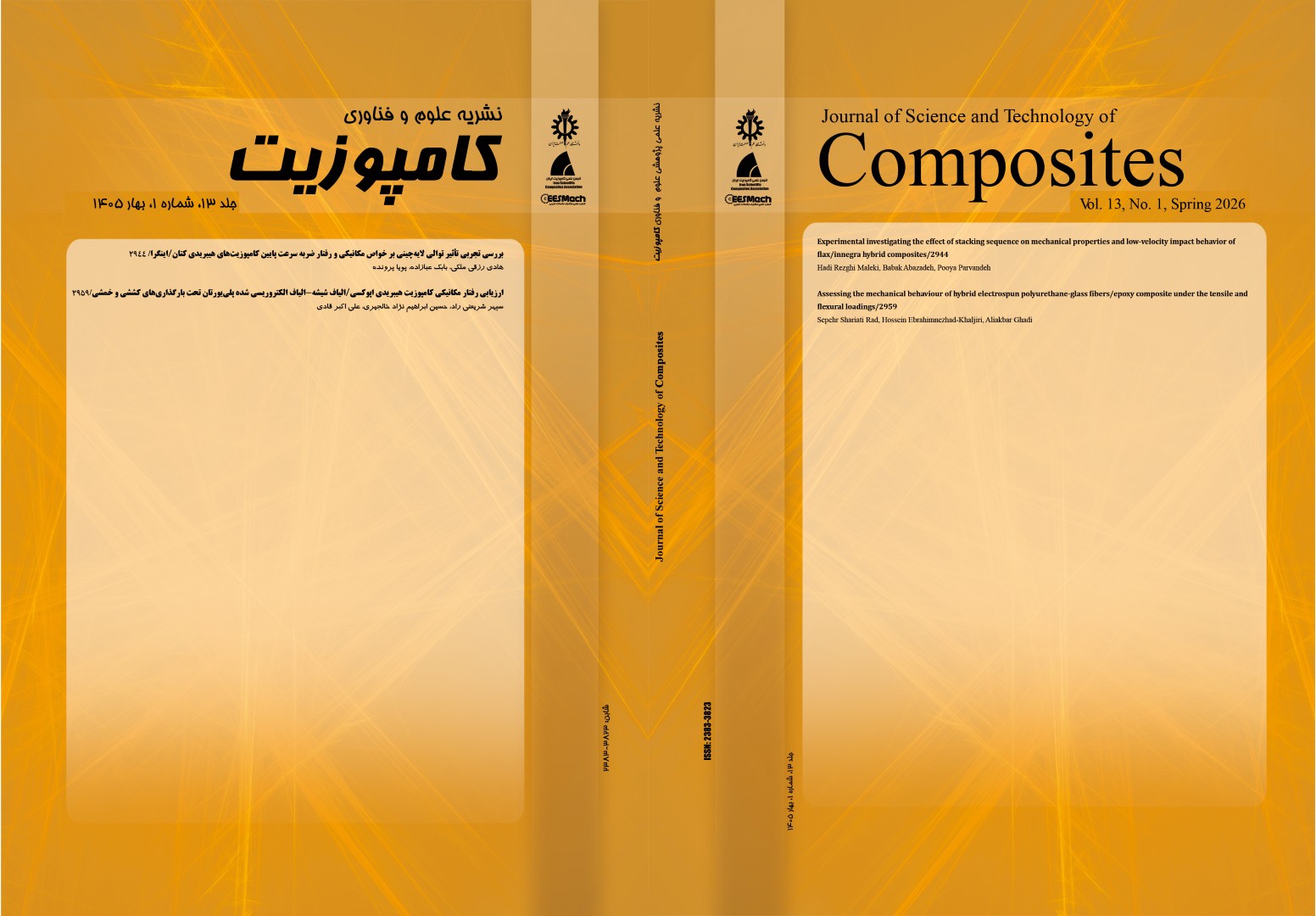
Journal of Science  and Technology of Composites

Journal of Science and Technology of Composites

Journal Statistics

Number of Submissions 966
Rejected Submissions 417
Rejection Rate 43
Accepted Submissions 482
Acceptance Rate 50
Time to Accept (Days) 201
Number of Indexing Databases 5
Number of Reviewers 588

Copyright

This is an open access journal distributed under the terms and conditions of the Creative Commons Attribution-NonCommercial 4.0 International (CC BY-NC 4.0) license. This license permits share (copy and redistribute the material in any medium or format) and Adapt (remix, transform, and build upon the material) under the Attribution-NonCommercial terms and properly citation to the original authors and JSTC.


Welcome


Journal of Science and Technology of Composites

The Journal of Science and Technology of Composites (JSTC), published by the Iran University of Science and Technology, is a peer-reviewed, open access journal dedicated to advancing research in composite materials. Due to the lack of specialized journals in the field of composites in the Persian language in Iran and the need to publish the findings of researchers, Iran University of Science and Technology, Iran Composites Scientific Association, and the Center of Excellence in Experimental Solid Mechanics in 2011 established the Journal of Science and Technology of Composites. The purpose of publishing this journal is to reflect the research findings of the academic and industrial experts in the field of composite materials and structures to university professors, researchers, students, and industrial experts.

The journal doesn't have any article processing charges (APCs) and submission charges.

Keywords Cloud

  • Mechanical properties
  • Composite
  • Delamination
  • Nanocomposite
  • energy absorption
  • sandwich panel
  • finite element analysis
  • Low velocity impact
  • composites
  • finite element method
  • Carbon Nanotube
  • Tensile strength
  • Basalt fibers
  • Microstructure
  • epoxy
  • High velocity impact
  • Micromechanics
  • Fiber metal laminate
  • Nanocomposites
  • Metal Matrix Composite
  • Creep
  • Wear
  • Free vibration
  • Graphene
  • Buckling
  • interface
  • Finite element modeling
  • Flexural properties
  • Carbon nanotubes
  • Shape memory alloy
  • Flexural Strength
  • centrifugal casting
  • numerical simulation
  • nano composite
  • Vibration
  • Fracture toughness
  • progressive damage
  • Corrosion
  • Polypropylene
  • Response surface methodology
  • Polyurethane foam
  • Surface modification
  • Taguchi method
  • Hybrid composite
  • Hardness
  • Matrix Cracking
  • Functionally graded material
  • Additive manufacturing
  • Low-velocity Impact
  • Nanoclay
  • Self-healing
  • tensile properties
  • Cohesive zone model
  • Hydroxyapatite
  • Cold spray
  • Acoustic emission
  • Epoxy resin
  • Composite plate
  • Laminated composite
  • 3D printing
  • Basalt
  • Composite plates
  • Shear strength
  • Impact strength
  • Guided waves
  • genetic algorithm
  • Representative volume element
  • Porosity
  • Polyamide 6
  • Nano silica
  • Impact
  • Polymer matrix composite
  • Composite beam
  • Bending behavior
  • analytical solution
  • Friction stir processing
  • Free Vibrations
  • experimental method
  • Finite element
  • Functionally graded materials
  • Stir casting
  • Modeling
  • Viscoelastic behavior
  • Surface treatment
  • modal analysis
  • Machining
  • Acrylonitrile Butadiene Rubber
  • Thermoplastic
  • Interphase
  • Galerkin method
  • FEM
  • Pultrusion
  • Dynamic response
  • Surface roughness
  • natural frequency
  • Adhesive joint
  • Laminated composites
  • Sandwich conical shell
  • Lamb wave
  • Foam
  • Optimization
  • Strain Rate
  • fatigue
  • mechanical behavior
  • Multi-walled carbon nanotubes
  • Strength
  • Strain energy
  • Continuum damage mechanics
  • quasi-static loading
  • FML
  • copper
  • Hot press
  • High temperature resin
  • Intermetallic Compound
  • Fiber metal laminates
  • Self-healing phenomenon
  • Aluminum
  • Ballistic Limit Velocity
  • Energy absorber
  • Three-point bending
  • Sandwich beam
  • Experimental study
  • smeared method
  • Natural fibers
  • Nano graphene
  • Damage
  • First-order Shear Deformation Theory (FSDT)
  • Polynomial chaos expansion
  • Vibration Control
  • Vibration correlation technique
  • Tool Wear
  • Composite patch
  • failure mechanisms
  • multiscale method
  • bending strength
  • Mechanical and physical properties
  • Temperature
  • Melt fluidity
  • Sintering
  • Morphology
  • Induced Delamination
  • Charpy impact
  • experimental analysis
  • Vibration Analysis
  • Hybrid core
  • ferrite
  • Wear test
  • Rectangular plate
  • GLARE
  • Composite cylindrical shells
  • Dynamic Loading
  • Composite tube
  • Finite element model
  • Wavelet transform
  • Fuzzy Controller
  • Curvilinear fiber
  • sandwich structure
  • Tensile behavior
  • Post-buckling
  • Strain energy release rate
  • Nitinol
  • Bending
  • Aluminium alloys
  • Nonlinear Forced Vibration
  • Sandwich shell
  • Nano clay
  • axial load
  • Nano-composite
  • Carbon fiber
  • Aluminum matrix composite
  • hybrid composites
  • Microhardness
  • dielectric constant
  • Mechanical joint
  • Drop impact test
  • Thermal environment
  • Thermal properties
  • experiment
  • composite coating
  • Sol-gel
  • Piezoelectric
  • Sandwich Panels
  • Composite Shell
  • stress intensity factor
  • Drilling
  • SiC
  • Layer-wise theory
  • Shot peening
  • Powder Metallurgy
  • EPDM
  • Thermoplastic Composite
  • Electrodeposition
  • Compressive strength
  • Mechanical milling
  • double cantilever beam
  • Frequency analysis
  • LS-DYNA
  • Extended Finite Element Method
  • Cohesive zone
  • Hot Rolling